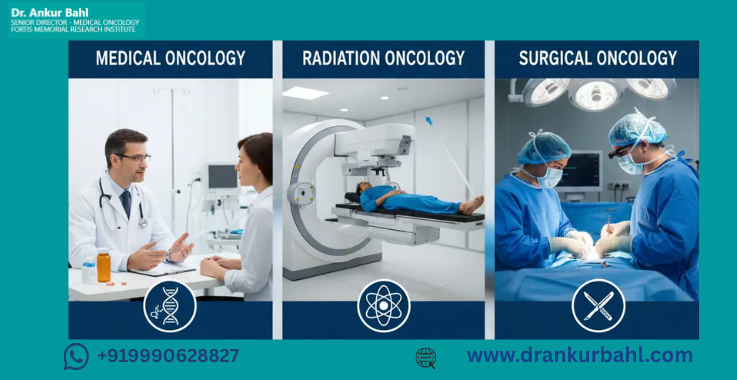
Understanding the Three Pillars of Modern Cancer Care
By Dr. Ankur Bahl
Cancer treatment today is no longer about a single doctor or a single treatment. It is a team-driven, highly specialized, and personalized approach that brings together different oncology experts to deliver the best possible outcomes for patients.
One of the most common questions patients and families ask after a cancer diagnosis is:
“Which oncologist should we consult—medical, surgical, or radiation?”
This confusion is completely understandable. Each type of oncologist plays a distinct yet interconnected role in cancer diagnosis, treatment, and long-term care. Understanding these differences helps patients make informed decisions, reduces anxiety, and improves treatment adherence.
In this detailed guide, Dr. Ankur Bahl, a renowned Medical Oncologist, explains the roles, responsibilities, and differences between Medical Oncologists, Surgical Oncologists, and Radiation Oncologists, and how they work together to fight cancer.
Why Cancer Treatment Requires a Multidisciplinary Approach
Cancer is not a single disease. It varies based on:
- Type of cancer
- Stage at diagnosis
- Tumor biology and genetics
- Patient’s age and overall health
- Response to treatment
Because of this complexity, modern cancer care relies on a multidisciplinary tumor board approach, where multiple specialists collaborate to design the most effective treatment plan.
At the core of this team are:
- Medical Oncologists
- Surgical Oncologists
- Radiation Oncologists
Each specialist contributes unique expertise at different stages of cancer care.
|
Type of Oncologist
|
Primary Role
|
|
Medical Oncologist
|
Treats cancer using medicines like chemotherapy, targeted therapy, immunotherapy, and hormonal therapy
|
|
Surgical Oncologist
|
Removes cancer through surgery and performs biopsies
|
|
Radiation Oncologist
|
Treats cancer using high-energy radiation to destroy cancer cells
|
What Is a Medical Oncologist?
A Medical Oncologist is the specialist who treats cancer using systemic therapies—medicines that travel throughout the body to target cancer cells wherever they may be.
Core Responsibilities of a Medical Oncologist
Medical oncologists are often the primary cancer doctors for patients. Their responsibilities include:
- Confirming diagnosis and cancer stage
- Planning and administering chemotherapy
- Prescribing targeted therapy and immunotherapy
- Managing hormonal therapy
- Monitoring treatment response
- Managing side effects of cancer treatments
- Coordinating care with other specialists
- Providing long-term follow-up and survivorship care
Treatments Given by Medical Oncologists
1. Chemotherapy
Uses drugs to kill fast-growing cancer cells. Chemotherapy may be:
- Curative
- Adjuvant (after surgery)
- Neoadjuvant (before surgery)
- Palliative (to relieve symptoms)
2. Targeted Therapy
Targets specific genetic mutations or proteins in cancer cells, causing less damage to healthy cells.
3. Immunotherapy
Boosts the body’s immune system to recognize and destroy cancer cells.
4. Hormonal Therapy
Used for hormone-sensitive cancers such as breast and prostate cancer.
When Do You See a Medical Oncologist?
- After cancer diagnosis is confirmed
- Before or after surgery
- When cancer has spread (metastatic cancer)
- For long-term cancer control and follow-up
In many cases, the medical oncologist becomes the central coordinator of a patient’s cancer journey.
What Is a Surgical Oncologist?
A Surgical Oncologist is a surgeon specially trained to remove cancerous tumors and nearby tissues safely and effectively.
Core Responsibilities of a Surgical Oncologist
- Performing biopsies to confirm cancer
- Removing primary tumors
- Removing lymph nodes for staging
- Performing minimally invasive or robotic surgeries
- Reconstructive surgeries (in some cancers)
- Assessing surgical margins to ensure complete removal
Types of Cancer Surgeries
- Diagnostic surgery – biopsy to confirm cancer
- Curative surgery – complete removal of tumor
- Debulking surgery – reducing tumor size
- Palliative surgery – relieving symptoms
When Is Surgery the Primary Treatment?
Surgery is often the main treatment when:
- Cancer is detected early
- Tumor is localized
- Complete removal is possible
For example:
- Early-stage breast cancer
- Colon cancer
- Certain head and neck cancers
In many cases, surgery is combined with chemotherapy or radiation for better outcomes.
What Is a Radiation Oncologist?
A Radiation Oncologist treats cancer using high-energy radiation that damages the DNA of cancer cells, preventing them from growing and dividing.
Core Responsibilities of a Radiation Oncologist
- Planning radiation treatment using advanced imaging
- Delivering precise radiation doses
- Protecting surrounding healthy tissues
- Managing radiation-related side effects
- Coordinating radiation with surgery and chemotherapy
Types of Radiation Therapy
1. External Beam Radiation Therapy (EBRT)
Radiation delivered from outside the body using machines like linear accelerators.
2. Brachytherapy
Radiation placed inside or near the tumor.
3. Stereotactic Radiosurgery (SRS/SBRT)
Highly precise radiation for small tumors.
When Is Radiation Used?
- As primary treatment for certain cancers
- After surgery to kill residual cancer cells
- Before surgery to shrink tumors
- For pain relief in advanced cancers
Radiation therapy is a powerful tool when used with precision and expertise.
Medical vs Surgical vs Radiation Oncologist: Key Differences
|
Aspect
|
Medical Oncologist
|
Surgical Oncologist
|
Radiation Oncologist
|
|
Treatment Type
|
Medicines
|
Surgery
|
Radiation
|
|
Scope
|
Whole body
|
Localized area
|
Targeted area
|
|
Role in Advanced Cancer
|
Primary
|
Limited
|
Palliative
|
|
Follow-up Care
|
Long-term
|
Short-term
|
Medium-term
|
|
Side Effects Managed
|
Drug-related
|
Surgical recovery
|
Radiation-related
|
How These Specialists Work Together
Modern cancer care is collaborative, not competitive.
Example: Breast Cancer Treatment Pathway
- Surgical Oncologist removes the tumor
- Medical Oncologist gives chemotherapy or hormonal therapy
- Radiation Oncologist delivers radiation to reduce recurrence risk
This teamwork ensures:
- Higher cure rates
- Lower recurrence
- Better quality of life
Why Medical Oncologists Often Lead Cancer Care
In cancers that:
- Have spread
- Are aggressive
- Require long-term treatment
Medical oncologists often act as primary decision-makers because systemic therapy is essential for controlling disease throughout the body.
Doctors like Dr. Ankur Bahl focus on:
- Personalized treatment planning
- Evidence-based medicine
- Advanced therapies
- Compassionate patient care
Choosing the Right Oncologist: What Patients Should Know
Patients don’t need to choose between oncologists—the right cancer center provides all three.
However, you should ensure:
- Multidisciplinary tumor board discussions
- Access to advanced diagnostics
- Experience in treating your cancer type
- Clear communication and transparency
Common Myths About Oncologists
Myth: Only one oncologist is needed
Fact: Most cancers require a team approach
Myth: Surgery alone cures cancer
Fact: Many cancers need additional therapies
Myth: Radiation is only for advanced cancer
Fact: Radiation is used in early and curative settings too
The Future of Oncology: Integrated and Personalized
Cancer care is evolving rapidly with:
- Precision medicine
- Genomic testing
- Immunotherapy combinations
- AI-driven treatment planning
The future belongs to collaborative oncology, where medical, surgical, and radiation oncologists work seamlessly together.
Final Thoughts from Dr. Ankur Bahl
Understanding the difference between Medical, Surgical, and Radiation Oncologists empowers patients and families to actively participate in their cancer care journey.
No single specialist works in isolation. Cancer treatment succeeds when expertise, technology, and compassion come together.
If you or a loved one is facing cancer, seek a center where all three oncology disciplines collaborate, ensuring comprehensive, evidence-based, and patient-centered care.